Warehouses, shops and loading areas
Forklifts, pallet jacks and dropped tools call for a high-build system, a thicker epoxy laid in more than one coat, so the floor stands up to wheels and impacts a thin coat won't.
Worn, peeling or stained concrete under carts and forklifts? We grind, test and coat it so the floor cleans easily and holds up.
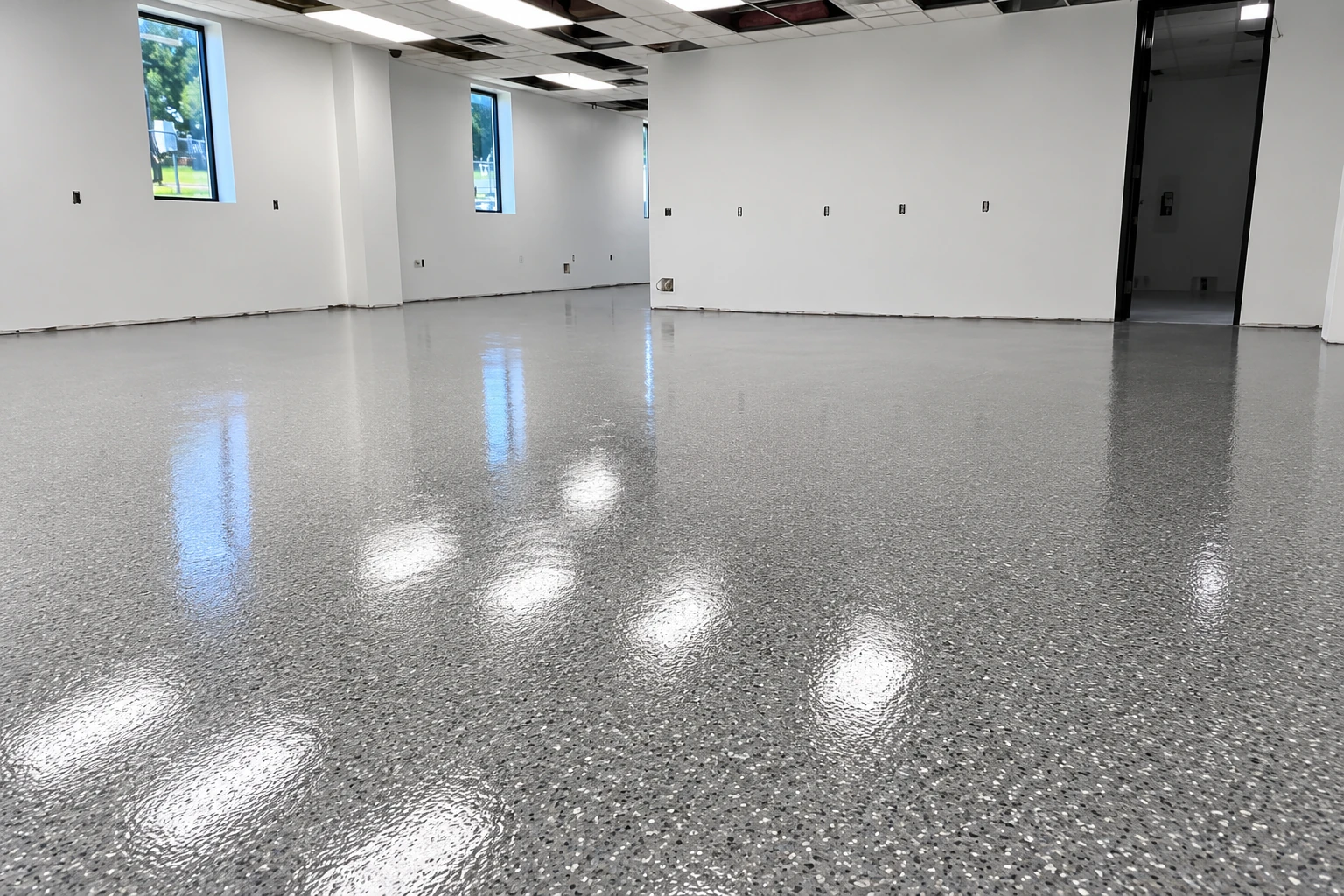
Commercial and industrial epoxy floor coating in Monterey, CA, is a resin system bonded to ground, cleaned concrete and built for the traffic, spills and cleaning your space sees, so the floor holds up for years instead of dusting and staining.
Most business owners call because bare concrete is dusting, staining or wearing through where the carts run, or an old coating has started peeling. The price mostly comes down to the size of the floor, how heavy a system your traffic calls for, how much prep the slab needs and whether the moisture test says it needs treating first. The schedule turns on how long you can close, how fast the system you pick cures and whether the space lets us work in sections. I come out, measure and test the slab, and you get your own figures in a written estimate.
We're based in Monterey and work across the peninsula, up through Salinas and over to Watsonville. In Monterey, the city's Building and Safety Division handles permits, and altering or improving a building under the city's codes needs its own permit first, so we check with the building office before we start and take care of the paperwork with you if one's needed. The city also points owners to the Contractors State License Board at cslb.ca.gov to check a contractor's license before hiring, and we're licensed and insured. The Monterey Bay Air Resources District caps VOCs, the solvents that evaporate as a coating cures, in floor coatings, so it's fair to ask which products we plan to use and whether they meet the district's limit.
Most floors that peel or bubble were rushed before the first coat went on, so we take the time to grind and clean the concrete until it's ready to hold a coating.
I learned this trade hauling grinders and mixing buckets for a crew that had done it for years, and we've been coating floors from garages to shops since 2013.
If a lighter system or a different floor suits your space better, I'll tell you so, because I'd rather you pay for the floor you need than the biggest one going.
For a business, the big question is usually how long you can close, so I start there and we plan the system and the schedule around it, coating one section while the rest stays open when the space allows. If you can only give us a day or two, I'll walk you through whether a polyaspartic floor coating fits your window better than a traditional epoxy.
I test the slab for moisture before I quote, because that's where these floors tend to go wrong. Plenty of commercial slabs push moisture up through the concrete, newer pours and slabs on grade with no vapor barrier under them most of all, and finding it at the estimate puts the fix in the price and the plan instead of halfway through the job.
Then comes the prep. One coating maker's instructions, for example, call for concrete that's roughened and opened up so it soaks in the primer, by mechanical means where possible, then cleaned of all dust, because a coating only holds as well as the surface under it. Our crew does the work with my lead installer running the job, and I'm on site checking in. If your space is really a shop bay or an oversized garage, our garage floor coatings may be the simpler fit, and I'll say so.
Forklifts, pallet jacks and dropped tools call for a high-build system, a thicker epoxy laid in more than one coat, so the floor stands up to wheels and impacts a thin coat won't.
Hot-water cleaning, steam and fast temperature swings put a lot of stress on a floor, so urethane cement is commonly chosen where a regular epoxy would be more likely to give out.
Standard epoxies can yellow or chalk under long sun, so for a floor by big windows or an open bay door, ask for a UV-resistant grade or an aliphatic topcoat, the sun-stable kind.
Foot traffic and the odd cart don't need a heavy system, so a light-duty thin-film coating usually does the job, and I'll tell you when that's the smarter buy.
Send the form and we'll reply within one business day to set a time. I come out to look at the floor, measure and test the slab, and the written estimate is free with no obligation.
A rough square footage helps me plan the visit, and I'll measure it properly on site, so a close guess is plenty when you fill out the form.
Tell us about forklifts, kitchens, washdowns, chemicals or sun through the windows, because the way the floor gets used decides which system makes sense for it.
Give us the days or hours the space could shut down, like weekends or a slow season, so I can plan the system and schedule around your real window.
Browse sample finishes, from flake and solid-color epoxy to polished and sealed concrete, to get a sense of what you'd like to talk over.
Straight answers to what business owners and property managers in Monterey ask us about cost, closing time, lifespan and kitchen floors.
Installed commercial epoxy flooring across the US usually costs about $3 to $12 per square foot, and that's a national market figure, not our price. Light-duty thin-film coatings sit at the low end, heavy-duty epoxy mortar or urethane cement for kitchens and food plants costs the most, and high-build warehouse and shop systems land in between. Your number comes from the written estimate.
A traditional epoxy system can take 3 to 7 days before it's ready for full traffic, while fast-cure systems like polyaspartic or MMA acrylic let people back on within hours. The fast-cure systems cost more in material, so it comes down to what each closed day costs your business. Tell us your window and we'll plan around it.
A properly specified and installed commercial epoxy system lasts 10 to 20 years. Heavy-traffic areas may need a fresh top coat every 5 to 7 years, so if your space is busy, it's worth putting that recoat in the long-term budget now. Our work is backed by our satisfaction guarantee.
Urethane cement is the common choice for kitchens, for the hot-water and steam reasons in the washdown card above. Before work starts, check the county side too, since in Monterey County a food facility remodel may need a plan check for changes to finishes, and existing facilities contact their assigned inspector or Consumer Health Protection before beginning work.
Ask what type of epoxy each proposal specifies, at what thickness, over which primer, and with which aggregate, the grit broadcast in for grip, and which topcoat. Two bids that both say "epoxy" can be very different floors, so putting those details side by side is how you see what you're actually paying for.
Call or send the form before your slow season, so we can fit the new floor into time you'd be quieter anyway.