Under new tile, vinyl or wood
When the slab under your next floor has humps, dips or rough spots, a leveler gives the new flooring a flat base so it lies down tight instead of showing every bump.
Humps, dips and rough patches under your old flooring? A thin pour gives you a smooth, flat surface so the next floor goes down right.
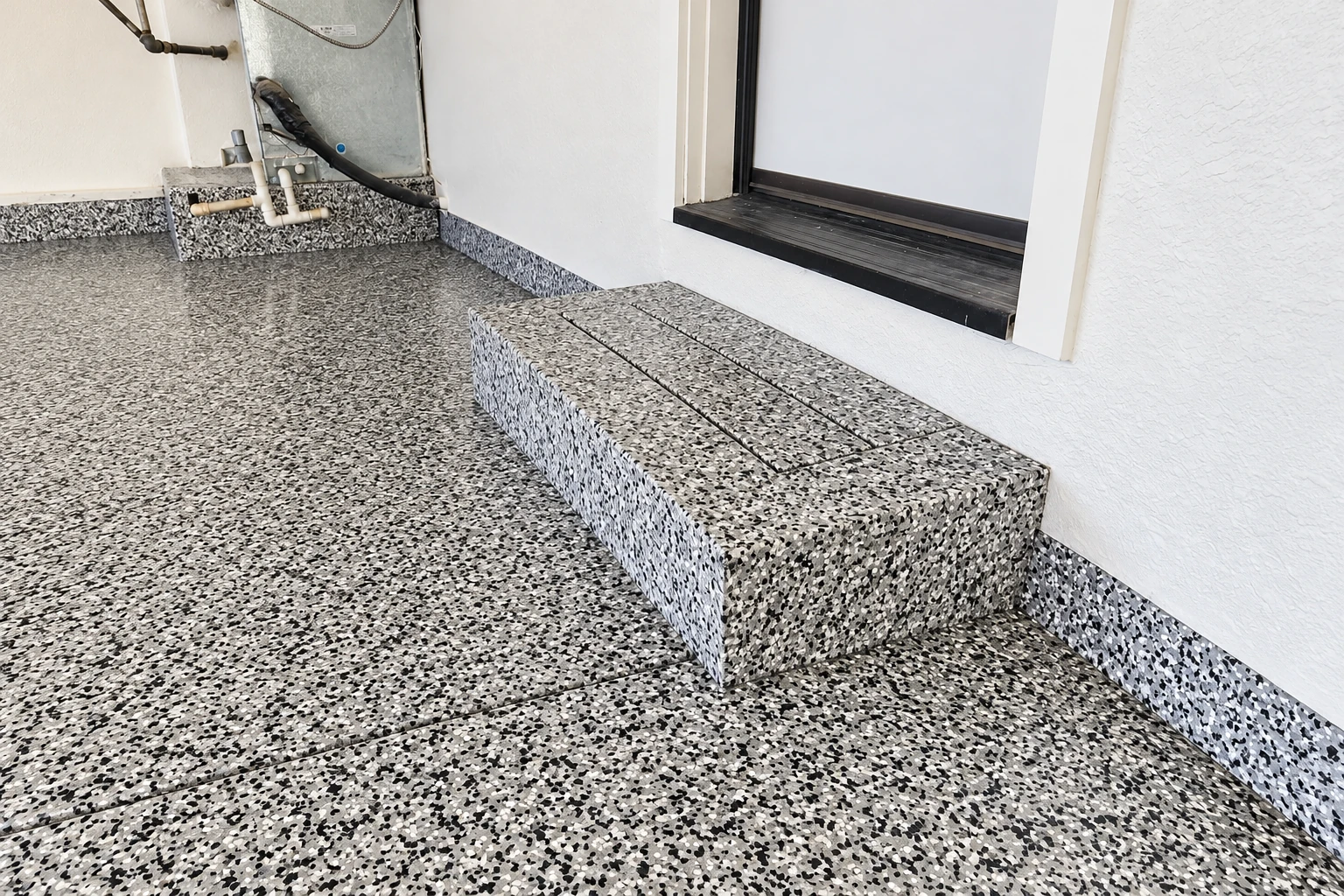
Self-leveling concrete in Monterey is a thin pour, usually under 2 inches, that flows out over an uneven floor and sets flat, and an overlay or resurfacer gives a worn slab a fresh surface without tearing it out.
Most of the price comes down to the size of the area, how much prep the floor needs, whether old glue or flooring has to come off first and what's going on top. The schedule turns on that same prep plus the cure before new flooring can go down, so your own numbers come from the written estimate after I've seen the floor.
I started this business in Monterey in 2013, and we work across the peninsula and the cities around it, up through Salinas and over to Watsonville, plus plenty of places in between.
Most floors that peel or bubble were rushed before anything went down on them, so we put our time into grinding and cleaning the slab before a leveler ever gets mixed.
If a thin pour isn't the right fix, or something simpler suits your floor better, I'll tell you straight, so you understand what you're paying for before you pay for it.
Before I quote, I check whether your floor is bumpy on top or has actually sunk, because a thin pour handles the first and not the second. I'll also tell you up front when the leveler is just a base that needs new flooring over it, so the estimate isn't missing half the job. While I'm there I test the slab, and one maker advises moisture-testing concrete to pick the right self-leveler.
Indoor floors and outdoor slabs take different products. One maker says its self-leveling underlayments are for interior floors only, while another makes a resurfacer for driveways, walks and patios, so where the job sits decides what we mix. If the slab you're worried about runs around a pool, our pool deck coatings and resurfacing work is the better fit.
Old tile or carpet glue usually has to come off first through our concrete floor stripping and removal work, and grinding that residue off by machine can be hazardous because it may contain asbestos. Then we grind, clean and prime, since primer is what makes the layer bond, and on porous concrete it keeps the pour from drying unevenly and cracking. Our crew does the work with my lead installer running the job, and I'm on site checking in.
When the slab under your next floor has humps, dips or rough spots, a leveler gives the new flooring a flat base so it lies down tight instead of showing every bump.
Homeowners call us about basements and garages a lot, and a slab that's rough or wavy on top is a good candidate for a pour, as long as it hasn't sunk.
Over plywood, one maker says the flooring, the load or the use may call for diamond mesh over the primed surface before the pour, which adds a step to the job.
Outside, a tired patio or walk takes a resurfacer made for outdoor slabs instead of an indoor leveler, so it gets a fresh top without being torn out and poured again.
Send the form and we'll reply within one business day to set a time. I come out to look at the floor, measure and test the slab, and you get a free estimate in writing, with no obligation.
A rough square footage helps, because the size of the area is a big part of the price and tells me how much material and crew time to plan for.
Let us know if it's a concrete slab, a plywood subfloor or an outdoor patio, since the product and the prep change with each one.
If old tile or carpet glue is still down, tell us early, because it has to come off before a pour and that changes both the prep and the price.
Example photos of leveled slabs, resurfaced patios and coated concrete floors to help you show us the finish and layout you have in mind.
Here are the questions people ask most when they're deciding whether a thin pour or overlay is right for their floor or slab.
Across the US, self-leveling concrete usually costs about $2 to $5 per square foot. That's the national range for the leveling work, not our price. Yours depends on the size of the area and how much prep the floor needs, and it comes in the written estimate after I've seen the floor. The work is backed by our satisfaction guarantee.
No, a thin pour won't fill hollows under a slab or lift concrete that has settled. It suits a floor that's uneven on top, with humps, dips or rough patches, not one that has dropped. If your slab has sunk, I'll tell you when I see it, since pouring over it won't fix what's going on underneath.
Usually not. One maker says its self-leveler isn't a final wear surface and has to be covered with a finished floor system, so when the product is an underlayment, a base layer that goes under flooring, plan on new flooring over it too. It's worth building that into your budget from the start.
They can. Joints or cracks that still move can carry up through a self-leveling layer and crack the finished floor on top. When I come out to look at your floor, point out any cracks you've seen open up or shift, so we can talk through them before anything gets poured.
Mostly keep the room closed up. One maker's steps call for doors and windows shut and heating and cooling off until the pour cures, with slab and room temperatures kept between 50°F and 95°F for at least 72 hours after. We'll go over what that means for your house before pour day.
California's licensing rules define a C-8 concrete contractor class for pouring and finishing flat concrete work and a C-15 flooring class for preparing surfaces for flooring. State safety rules also require a dust reduction system whenever crews grind or cut concrete with power tools, so expect dust control when we grind your slab before a pour. We're licensed and insured.
Call (831) 204-4420 or use the form, and mention the room size and floor type so I show up ready to test the right things.