Home garage floors
A coated garage floor stops the dust, keeps oil and road grime on top where you can wipe it up, and gives you a clean, bright floor to work on.
Peeling, stained or dusty concrete? We grind the slab, test it for moisture and lay down an epoxy coating built to hold on.
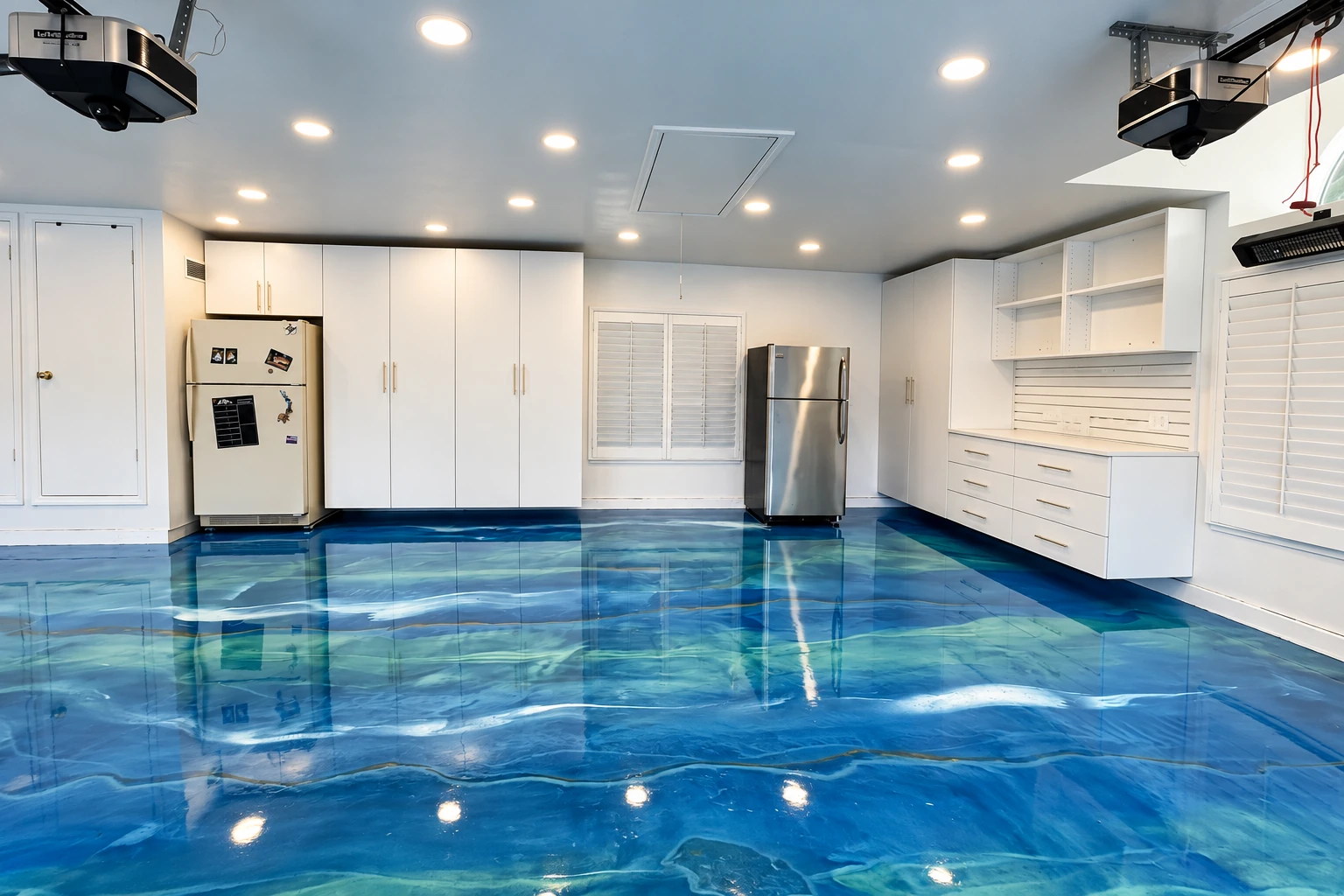
Epoxy floor coatings in Monterey, CA bond layers of resin to your concrete, turning a dusty, stained slab into a hard, sealed floor that wipes clean and holds up to cars, tools and foot traffic.
Most people call me about a garage floor that sheds dust, soaks up oil or has a store-bought coating lifting in patches, and sometimes it's a basement or a shop floor that's taking a beating. More paint won't fix any of those. What fixes them is a coating bonded to concrete that was actually ready for it, and that's where most of the work goes.
The price moves with the size of the floor, how much grinding and crack repair the slab needs, whether an old coating has to come off first, and which system and topcoat you pick. The schedule turns on the concrete being ready on the day we start, plus the time the coating needs to cure before you drive on it. I come out, measure and test the slab, and you get the estimate in writing.
I come out to look at the floor, measure it and test the slab before you get a price, so the estimate is built on your concrete and not a guess from a photo.
If a sealer or a simpler coating suits how you use the space, I'll tell you, because you should know what you're paying for before you pay for it.
I learned on a coating crew, hauling grinders and mixing buckets for people who'd done it for years. We've been in business since 2013, so nobody's learning on your floor.
With epoxy the slab does most of the work, so we grind it instead of acid washing it. Grinding takes off the weak top layer and leaves the concrete rough and open, which gives the primer something to bite into. From there the floor goes on in layers: a primer that bonds and seals, a body coat that builds thickness and strength, and a polyaspartic or urethane topcoat that takes the wear.
Before the first coat goes down, we check the slab's moisture and temperature, and if the concrete isn't ready that day, we wait. One epoxy maker's guide for its own floors calls for concrete at least 50°F and at least 5.5°F above the dew point, the temperature where moisture starts to condense on a surface. This past August, Monterey Airport averaged a daily high of 67.8°F with 80 percent relative humidity, and a cool slab under damp air like that can sit close to the line, so we measure it instead of guessing.
The product has to suit Monterey too, since the local air district limits the VOC content, the solvent vapor a coating gives off, of coatings put on buildings, so what we put down has to fall within those limits. Our crew does the work with my lead installer running the job, and I'm on site checking in. It's the same process for garage floor coatings at home and for commercial and industrial epoxy floor coatings on shop and work floors that take a beating.
A coated garage floor stops the dust, keeps oil and road grime on top where you can wipe it up, and gives you a clean, bright floor to work on.
Basement slabs sit against the ground, so the moisture check carries the most weight there. When the slab passes, epoxy gives you a sealed floor that's easy to keep clean.
Business owners call us when a floor has to take carts, equipment, dropped tools and spills, and a thick epoxy body coat under a tough topcoat is built for that.
When a store-bought coating is peeling, we grind it off down to sound concrete first, because a new coat laid over loose material comes up right along with it.
Send the form and we'll reply within one business day to set a time. I'll come out, measure and test the slab, and you'll get a free written estimate with no obligation.
A rough size in square feet, even from pacing it off, helps us plan the visit and gives us both a sense of scale before I measure it properly.
Photos of stains, cracks or an old coating that's lifting show me what the slab has been through, so I know what to look at closely when I come out.
Parking, a workshop, a home gym or a business floor all wear differently, and that steers which system and topcoat make sense for your space.
Look through solid colors, flake blends, metallic finishes and clear topcoats over concrete, and point out what you like when we meet.
Here's what people around Monterey ask about epoxy floors, from cost and lifespan to moisture, permits and checking a contractor's license.
Professional epoxy floor coating across the US usually costs about $3 to $12 per square foot installed, according to one national cost guide. That guide puts single-coat solid colors at the low end, flake systems higher, and premium polyaspartic or metallic systems at the top. Your written estimate comes from me measuring and testing your own slab.
A professionally installed epoxy floor on a properly prepped slab typically lasts 10 to 20 years in a home garage, by one cost guide's count, against 1 to 3 years for a DIY kit. The same guide says a polyaspartic topcoat stretches that to 15 to 25 years and resists the yellowing sunlight can cause. Our work is backed by our satisfaction guarantee.
Not according to one cost guide, which names diamond grinding or shot blasting as the only acceptable prep and calls a properly prepared slab the difference between a 20-year floor and a 2-year floor. Kits mostly fail because the concrete wasn't roughened enough or tested for moisture. If you're comparing quotes, ask each company which prep method its price includes.
Too much moisture in concrete can discolor a coating, interrupt its cure and make it peel off in layers. Concrete has no reliable fixed drying time, since that depends on the mix, thickness, curing, the vapor barrier under the slab and the air around it. So I test your slab against the limits of the product we're putting down.
Monterey's Building and Safety Division is the place to ask. It issues permits for building work the codes cover, and even for work that needs no building permit, it asks owners to check first, since a permit or another approval may still be needed. We check with the building office before we start, and if a permit's needed, we handle the paperwork with you.
Look the contractor up with the Contractors State License Board before you hire, either on the board's website or through its toll-free phone line, which is where the city points owners. We're licensed and insured, and you're welcome to check us before I ever come out.
Our phone hours run into the evening, so call (831) 204-4420 after work or send the form whenever it suits you.