Garages you use every day
If your car lives in the garage and there's nowhere else to put it, the short cure is the whole point, since you're parking again much sooner than with epoxy.
Garage floor chipped, stained or dusty? We fix and grind the concrete first, then coat it so you get your garage back sooner.
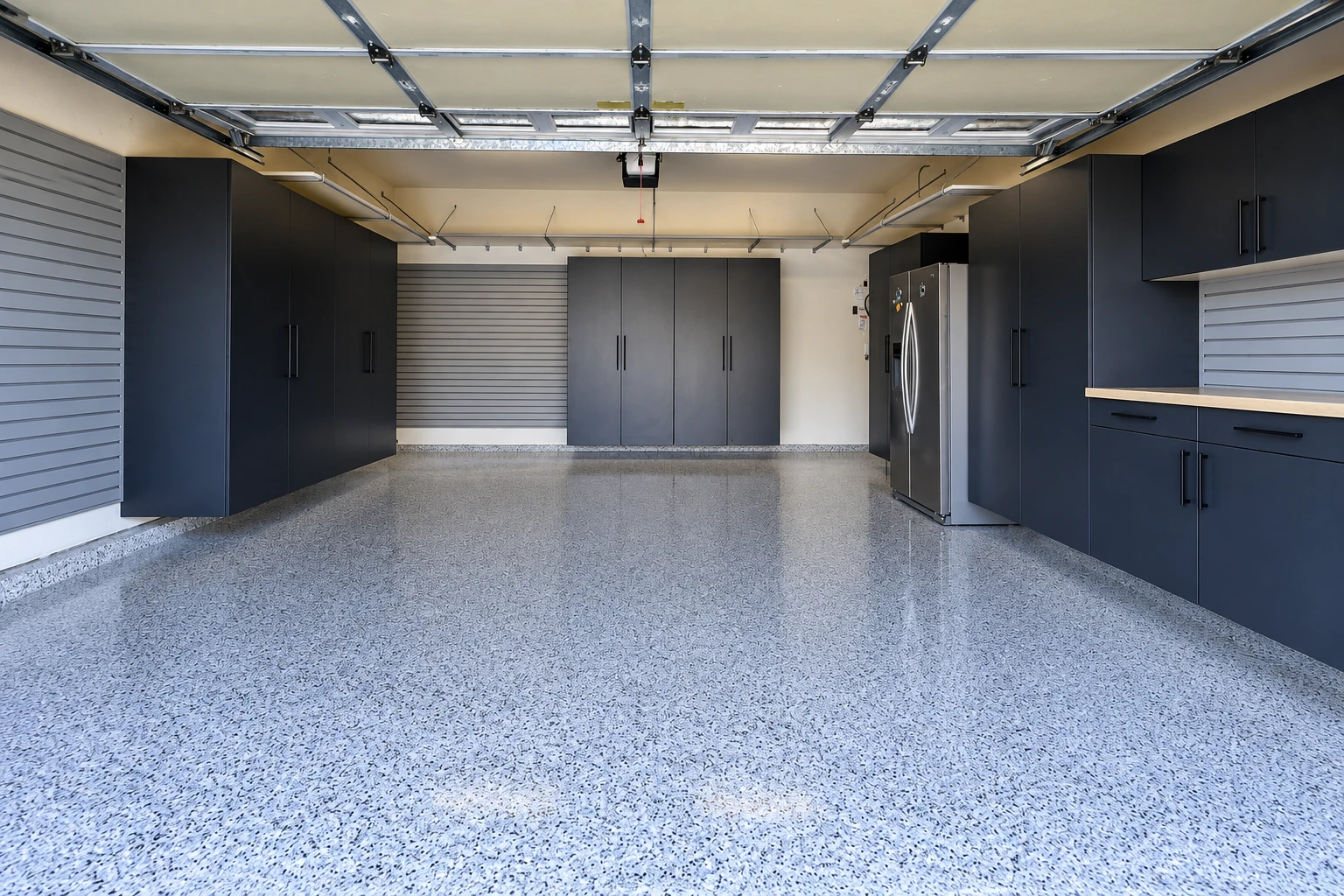
Polyaspartic floor coatings in Monterey give your garage a hard, easy-to-clean finish that sets fast, so you're back to using the space much sooner than you would be with epoxy.
Most people call us because the garage floor is stained, chipped or throwing off concrete dust, and they've heard polyaspartic is the fast option. It is. It also costs more up front, and some product lines offer fewer colors and decorative looks than epoxy, so I lay out both sides and let you decide if the speed and the longer life are worth it. If color choice matters most to you, epoxy floor coatings may suit you better.
The price moves with the size of the floor, how many cracks and chips need repair, whether old paint or coating has to be ground off, and whether built-in cabinets or shelves have to come out. The schedule turns on that same prep, on what the moisture test shows and on the weather the day we coat. Your written estimate gives you your own number. We do this work in Monterey and across the peninsula, up through Salinas and over to Watsonville.
Most floors that peel or bubble were rushed before the first coat went down, so we repair cracks and grind the slab first, even though it's the slowest, dustiest part of the job.
Polyaspartic costs more and sets faster, while epoxy costs less and takes longer. I'll show you where your money goes and tell you straight if the simpler option fits your garage better.
I learned this work hauling grinders and mixing buckets for a coating crew, and I've run this business in Monterey since 2013, so I know where these floors usually go wrong.
Polyaspartic sets fast and forgives nothing, so crack repair and grinding come first. Once it's mixed there's no time to go back for a low spot or a crack somebody missed, and anything you coat over shows right through.
We fill the cracks and patch chipped spots, then diamond-grind the whole slab, which roughs up the surface so the coating has something to bite into. That's the big difference from a store-bought kit, because acid etching just doesn't give the coating the same grip. After that we vacuum the dust, coat the floor and clean up.
Polyaspartic isn't the answer for every floor, and I'll say so. If you want a showpiece swirl or a color the polyaspartic lines don't carry, metallic epoxy flooring gives you far more to work with. If the floor takes hot water, harsh cleaners or heavy equipment, urethane cement flooring is the tougher pick, and if budget leads, plain epoxy is a fair choice with a longer wait.
If your car lives in the garage and there's nowhere else to put it, the short cure is the whole point, since you're parking again much sooner than with epoxy.
Polyaspartic won't yellow or fade, even with heavy sun on it, so it suits garages where the door stays open or light pours through the windows all afternoon.
A hard, sealed surface shrugs off dropped tools, oil and sawdust and sweeps clean, and you're back at the bench quickly instead of storing everything somewhere else.
A business that can't close for long loses less time with a fast cure. If your floor sees harsh chemicals or hot washdowns, I'll point you to something tougher.
Send the form and we'll reply within one business day to set a time. I come out, look at the floor, measure and test the slab, and you get the estimate in writing, free and with no obligation.
I come out myself to look at the floor, measure it and test the slab, so the repairs and grinding it needs are in the estimate rather than found halfway through.
You get the estimate on paper, so you can set it beside other quotes and ask each contractor how they'll prep the floor before any coating goes down.
My lead installer runs the crew on your job and I'm on site checking in, so the floor we talked about at the estimate is the floor that gets done.
Example floors with flake blends, solid colors, metallic swirls and different gloss levels, handy to point at when we talk about your own floor.
Here's what Monterey homeowners usually ask about polyaspartic coatings, from parking times and lifespan to cost, permits and moisture in the slab.
Usually within 24 hours for your car and 4 to 6 hours for walking on it, according to a national guide, compared with 5 to 7 days for epoxy. Cold slows that down, since one maker says lower temperatures stretch the cure, and another wants the air between 40 and 90°F while it goes on, so the day we coat matters.
Usually 10 to 20 years or more with little upkeep for a professionally installed system, against 5 to 10 years for epoxy, according to a national pricing guide, depending on traffic and care. That longer life is a big part of what you're paying for up front. It only holds if the coat bonds, and our work is backed by our satisfaction guarantee.
Usually about $6 to $10 per square foot across the US for a polyaspartic or polyurea garage coating, going by a national pricing guide, so that's the market's range and not our price. Yours moves with the size of the floor, how much repair and grinding it needs and whether cabinets have to come out, and I put it in writing after I see it.
Only a licensed contractor or the building owner can pull a building permit in Monterey. Before the city issues one, the contractor needs a state contractor's license, a workers' comp insurance certificate and a current city business license. We're licensed and insured, and if your job might need a permit, we check with the city and do the paperwork with you. The city's building division takes questions at 831-646-3890.
Usually because the slab was rushed or was pushing up too much moisture. One coating maker says ground-level slabs give off moisture vapor, and too much of it can make a coating blister and peel loose. That maker calls for a calcium chloride test, plus a vapor control system before coating when levels run high, which is why I test your slab before writing the estimate.
Possibly, because the Monterey Bay Air Resources District requires approval for some renovation and demolition projects to keep asbestos out of the air. That matters most when old flooring or adhesive comes up before we grind. The district can tell you whether your project falls under its asbestos rules at 831-647-9411, and it also sets limits for floor coating products.
Call or send the form with your garage's rough square footage and whether built-in cabinets are staying, and I'll come out knowing what to check.